Temporary Closures: Current advice


Reconciliation Place
Image
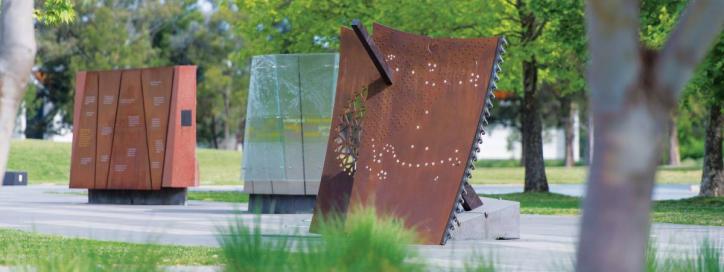
Reconciliation Place, Parkes.
We acknowledge the traditional custodians of this land and pay respect to their leaders, past and present. Visitors to this website should be aware that names may be mentioned, or images portrayed, of people who are now deceased. Any distress this may cause is sincerely regretted.
Ngunna yerrabi yanggu is a traditional welcome to Ngunnawal country meaning ‘(you may) walk on this country now'.
Listen to the Audio tour
As you walk amongst the artworks, use your device (phone, laptop etc) to hear about the works and what they represent. Starting at the National Library end you can listen to:
Introduction
Fire and Water by Judy Watson
Methalu Tharri (Smooth Sailing) by Vic McGrath
Separation 1
Separation 2
Kwi’ith, Man and Woman Yam by Dr. Gloria Fletcher (Thancoupie)
Strength, Service, and Sacrifice
Ngunnawal
The Mound
Leadership
Referendum
Women
Wati Jarra Jukurrpa (Two Men Dreaming)
Land Rights
The Stone Artworks
Ruby Florence Hammond
Robert Lee
Wenten Rubuntja
Bill Neidjie
Gatjil Djerrkura
Take a self-guided walking tour of Reconciliation Place.
On 22 May 2000, as a symbol of the Government's commitment to the ongoing reconciliation process, Prime Minister the Hon John Howard MP announced a ‘reconciliation square' (as it was then called) would be constructed in the National Capital. On 7 December 2000 he then announced Reconciliation Place would be constructed in the National Triangle. The site is at the junction of Walter Burley Griffin's Land Axis and the pedestrian cross-axes between the National Library of Australia to the west and the High Court of Australia to the east. The selection of this location places the reconciliation process physically and symbolically at the heart of Australian democratic and cultural life.
A national design competition was launched on 28 February 2001. The competition closed on 9 May 2001 and 36 entries were received. The winning design team was:
Architect: Kringas Architecture
Indigenous Cultural Advisor: Sharon Payne
Exhibit Design Consultant: Alan Vogt
Architectural Assistants: Amy Leenders, Agi Calka and Cath Eliot
It was an essential requirement of the design competition that an Aboriginal or Torres Strait Islander person form part of the design team. Reconciliation Place was officially opened on 22 July 2002 by Prime Minister the Hon John Howard MP.
The Artworks at Reconciliation Place include:
- Fire and Water
- Methalu Tharri (Smooth sailing)
- Separation 1
- Separation 2
- Kwi'ith, Man and Woman Yam
- Strength, Service and Sacrifice
- Ngunnawal
- Leadership
- Referendum
- Women
- Land Rights
- Wati Jarra Jukurrpa (Two Men Dreaming)
-
The Stone Artworks: Ruby Florence Hammond PSM, Robert Lee, Wenten Rubuntja AM, Bill Neidjie OAM and Gatjil Djerrkura OAM.