Temporary Closures: Current advice


Commonwealth Place
Image
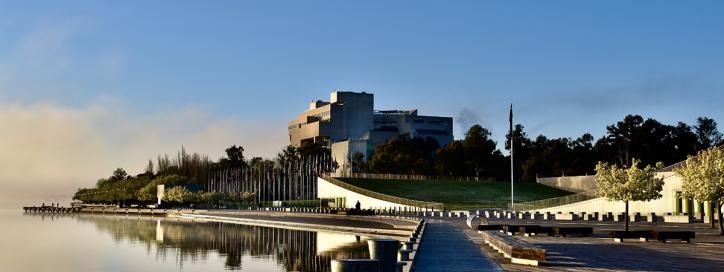
Commonwealth Place, Parkes.
Commonwealth Place is a vibrant public space located on the southern shore of Lake Burley Griffin within the National Triangle. Spanning a grassed, cupped square approximately 100 metres by 50 metres, it was designed as a flexible community gathering place that accommodates everything from major national events and ceremonies to informal family outings and recreational activities.
Centred on Walter Burley Griffin's Land Axis, Commonwealth Place features a sandstone-clad pedestrian walkway that links the site to Reconciliation Place. The walkway is paved in Australian bluestone and passes through the landscaped square, while the undercroft spaces beneath provide accommodation for café, restaurant and office facilities. The western side of the square is shaded by a grove of trees planted in the form of the Southern Cross and Speakers Square, a Centenary of Federation gift from the Canadian Government, creates a focal point for celebrations, ceremonies and flag-raising events.
Completed in 2002, Commonwealth Place was later enhanced through the development of the forecourt area between the site and the lake's edge. This extension introduced a shared pedestrian zone and 2 jetties, strengthening the connection between Commonwealth Place and Lake Burley Griffin. The forecourt increases opportunities for recreation on the water, allowing small craft such as rowing sculls, yachts and dinghies to land easily from a variety of directions. Reflecting a commitment to sustainability, the jetties were constructed using recycled timber, while recycled plastic was also incorporated into the works.
Commonwealth Place was designed by Durbach Block Architects in association with Sue Barnsley Design and received the Royal Australian Institute of Architects' Australian Capital Territory Chapter Urban Award in 2003.