Temporary Closures: Current advice


1921 - 1924: Federal Capital Advisory Committee
Image
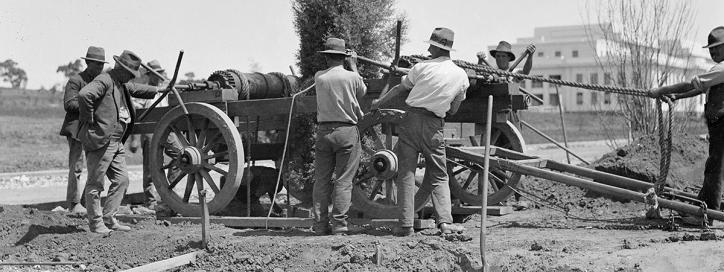
Advanced tree planting with mobile windlass 1927.
Image courtesy of the National Archives of Australia. NAA: A3560 6554
Role: To advise the Minister of Home Affairs on the construction of Canberra and review the Griffin Plan.
The Federal Capital Advisory Committee comprised Sir John Sulman,(Chairman), an Australian architect, together with an engineer, the Director-General of Works and the Surveyor-General.
The Committee proposed Canberra be developed in 3 stages. The first stage, to take 3 years, would see the Parliament and key administrative staff moved from Melbourne and housed in Canberra. The second stage, to be carried out over the following 3 years, would see the transfer of some government departments to Canberra, construction of an additional railway connection and construction of permanent architectural and engineering works. No time limit or estimated cost was provided for the third stage, which was intended to provide character and permanence to the capital. The Government accepted the Committee's recommendations but little progress on development was made.
The first sod for the provisional Parliament House was turned on 28 August 1923. The building was located below and in front of the site designated for Parliament House in Griffin's plan. A construction railway began operating between the brickworks in Yarralumla and major building sites and a passenger rail service to Canberra via Queanbeyan commenced in October 1923.
The first land auction for residential and business sites was held in December 1924 shortly before the Advisory Committee was abolished following dissatisfaction with the pace of development. At this time, Canberra had about 3,000 residents, most of whom were workmen and their families living in camps or under canvas.
Keep reading, next up: 1925 - 1930 Federal Capital Commission | National Capital Authority