Temporary Closures: Current advice


1938 - 1957: National Capital Planning and Development Committee
Image
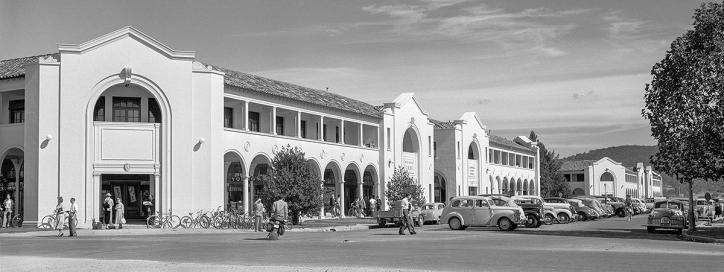
Cities and towns, Civic Centre and private home in Turner, Canberra, 1955.
Image courtesy of the National Archives of Australia. NAA: A7973, INT407/1
Role: Advisory body to the Minister of the Interior to safeguard the Griffin Plan and maintain high aesthetic and architectural standards worthy of a National Capital.
The Great Depression of 1929 - 1933 brought almost all construction to a halt in Canberra. By 1938, when a new advisory body was appointed, Canberra consisted of a handful of suburbs housing about 7,000 people,. These suburbs were separated by open paddocks and the flood-plain of the Molonglo River.
At the centre of this largely rural setting, within the Parliamentary Triangle, stood the provisional Parliament House, flanked by the East and West Block Offices. Beyond these buildings were the lucerne flats and the willow-lined bed of the Molonglo River.
The outbreak of the Second World War in 1939 highlighted limitations in Canberra's development as the National Capital. The lack of facilities in Canberra led to the expansion of government departments in Melbourne and Sydney. As a result, the war effort was coordinated across the three cities with officials travelling regularly between them.
The first decade after the war was marked by material shortages and the construction of a number of temporary buildings to accommodate public servants. Plans to transfer 7,000 public servants from Melbourne were abandoned.
Although the National Capital Planning and Development Committee provided advice on Canberra's development, it did not have executive powers. Over time its recommendations were increasingly bypassed and decisions, including variations to the Griffin Plan, were made without reference or referral to the Committee.
Concerns about the pace and coordination of Canberra's development led the Government to establish a Senate Select Committee in 1954. The Committee recommended significant changes, including the creation of a single authority responsible for planning, developing and constructing the National Capital, supported by adequate finance and a coordinated development plan.
Moving on: 1958 - 1989 National Capital Development Commission | National Capital Authority