Temporary Closures: Current advice


1958 - 1989: National Capital Development Commission
Image
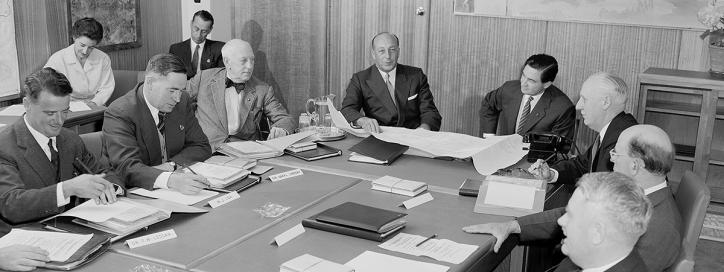
Mr Fairhall at meeting (planning and development commission), Canberra, 1958.
Image courtesy of the National Archives of Australia. NAA: A1200, L25942
Role: To Plan, develop and construct Canberra as Australia's National Capital.
Commissioners
- Sir John Overall, 1958-1972
- W.C. Andrews, 1972-1974
- Tony Powell, 1974-1985
- Malcolm Latham, 1985-1989
The National Capital Development Commission (NCDC) identified 4 principal tasks in its first annual report: complete the establishment of Canberra as the seat of government; to further its development as the administrative centre by providing facilities to support the continued transfer of public servants from Melbourne; to give Canberra an atmosphere and individuality appropriate of a national capital; and to support the growth of the city as a place in which to live in comfort and dignity. Over the next 31 years the Commission implemented many elements of this vision.
Image

Hand-over ceremony for Henry Moore's sculpture "Two-piece reclining figure no. 9" outside the Australian National Library, Canberra, February 1970, National Capital Development Commission.
National Library of Australia, nla.obj-146743758-m
The NCDC's first major task was to implement the lake scheme in the Griffin Plan. Completed in 1964, the scheme created an ornamental and recreational waterway surrounded by extensive lakeshore parklands.
The Commission adopted a Y-Plan for decentralised development and established 4 new towns; Woden-Weston Creek, Belconnen, Tuggeranong and Gungahlin - to accommodate rapid urban growth. At the same time, the NCDC delivered major projects of national significance, including the Russell Hill Defence Offices, construction of Anzac Parade and its associated monuments and memorials, and the planning of sites for an increasing number of diplomatic missions.
The design and construction of major institutions in the Parliamentary Triangle, including the National Library of Australia, High Court of Australia, National Gallery of Australia and the National Science and Technology Centre, contributed to the realisation of Griffin's vision for the capital. The development of the National Capital Open Space System addressed environmental considerations while also providing recreation opportunities for a rapidly growing population.
Canberra's population increased from almost 40,000 to just under 300,000 during the NCDC's 31 years of operation.
With the completion of the new Parliament House on Capital Hill in 1988 (constructed by the Parliament House Construction Authority rather than the NCDC) and the proposed introduction of self government into the Australian Capital Territory, the Government believed the Commission's role had largely been fulfilled.
The NCDC was abolished in 1989 and most of its functions and staff were transferred to the Australian Capital Territory Government. A new National Capital Planning Authority was established to represent the Commonwealth's interest in the future planning and development of the National Capital.
National Capital Planning Committee
Role: Advisory committee to the National Capital Development Commission (NCDC).
The Committee was chaired by the NCDC Commissioner and comprised 6 nominated representatives from the Royal Australian Institute of Architects, the Institution of Engineers, Australia and the Royal Australian Planning Institute, together with 2 members appointed for their knowledge and experience in cultural matters.
Image
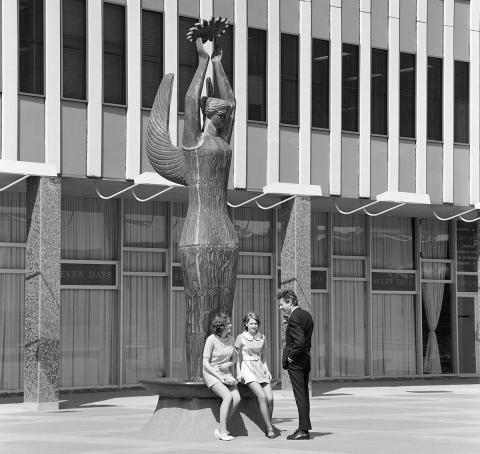
The National Capital Planning Committee first met on 16 April 1958, replacing the National Capital Planning and Development Committee, which had operated for the previous 20 years.
All major planning and development proposals prepared by the NCDC were referred to the Committee for comment. Through its changing membership, the Committee provided advice to the NCDC on matters referred to it by the Commission and contributed to the consideration of the design and development of the National Capital.
The Committee was abolished with the introduction of self-government to the Australian Capital Territory in 1989 and the establishment of the National Capital Planning Authority (now the National Capital Authority).
Read about the beginnings of the National Capital Authority: 1989 to Present Day National Capital Authority | National Capital Authority